What the study actually found
Among companies hit by a downturn, one third chose to cut their marketing budget (by 11% on average). The remaining two thirds increased it - 60% of those only modestly (by 10% on average), and 40% substantially (by 49% on average).
Here's the important part. Companies that cut spending saw ROI decline by 1.6 percentage points. Companies that increased spending modestly saw ROI decline by 1.7 percentage points - essentially the same outcome. In other words, cutting didn't save anyone. It looked like savings in the short term, but the bottom-line result was just as bad as if the company had left marketing alone and only nudged it up slightly.
Then there's the group that increased spending substantially (by 49% on average). Yes, in the short term they took a slightly bigger hit to profitability too (ROI down 2.7 percentage points) - but they gained roughly double the market share compared to the companies with a modest increase. And market share gained during a downturn, when competitors are pulling back and visibility is cheaper, tends to stick around long after the downturn ends.
This is exactly what makes a marketing budget a different category of expense than, say, buying office equipment. Marketing doesn't react to how much a company is earning right now - marketing determines how much it will earn next.
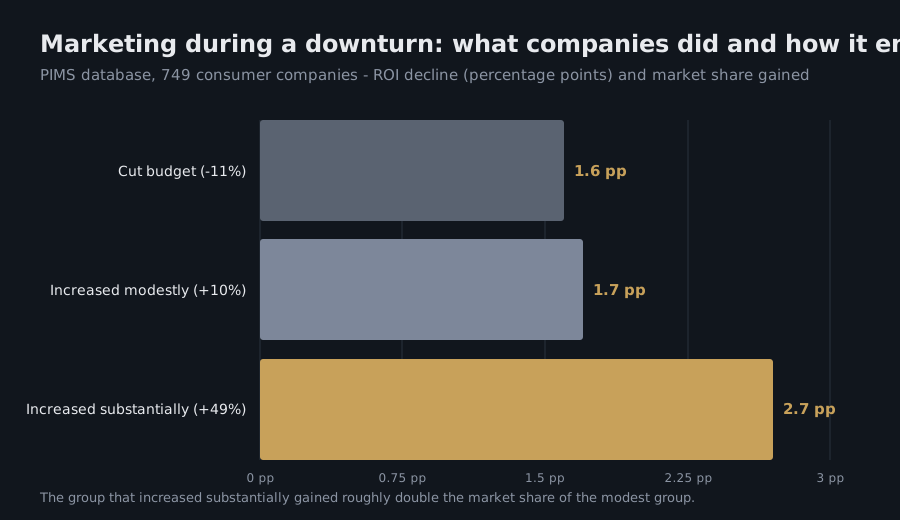
Source: analysis of the PIMS database (749 consumer companies) - Medium / WARC.
A real-world example: Netflix during the 2008-2009 recession
This isn't just an academic study. During the 2008-2009 financial crisis, when most companies were slashing marketing budgets across the board, Netflix went the other way - it kept investing in marketing and product at a time when its main competitor, Blockbuster, was pulling back. The result: Netflix ended 2008 with more than 9 million subscribers, up from roughly 7.5 million at the start of the year - growth of about 26% in a year when the U.S. economy was sliding into its worst recession since the 1930s. A year later, in 2009, Netflix crossed 12 million subscribers. A company that looked at the time like a "streaming upstart" laid the groundwork for a position from which it would go on to redefine the entire industry a few years later - while Blockbuster, which responded to the crisis with the typical cost-cutting playbook, including marketing, filed for bankruptcy in 2010.
That's not proof that "spend more, always win" is a universal law - Netflix also had a strong product and the right timing on streaming technology. But it's exactly the pattern the PIMS study describes: a company that didn't cut marketing during a downturn came out with market share gains that proved durable.
Expert perspective: "I see this across industries again and again - the moment things slow down, marketing is the first line item on the chopping block, because it looks 'optional.' The reality is the opposite: it's the one line in the budget that decides whether the company will even have anyone to sell to once the downturn ends," says **Michal Krčmář, founder of Don Marketer and a CMO with nearly two decades of experience in global marketing.
That's why it's calculated from revenue, not profit
Look at how the industry as a whole plans marketing budgets - whether it's the Gartner CMO Spend Survey, The CMO Survey, or any other credible benchmark - and you'll run into the same logic every time: the budget is set as a percentage of revenue, not profit and not EBITDA. The reason is straightforward once you think about what marketing is actually for.
Marketing's primary job is to grow or protect revenue, not to react to current profitability. If the budget were derived from profit, a company with temporarily low profit (typically a growing company in its early years, or one going through a rough patch) would have to cut marketing at exactly the moment it needs it most to get out of that situation. That creates a vicious cycle: low profit → less marketing → fewer new customers → even lower profit → even less marketing.
Revenue is also a simpler, more comparable number. Profit and EBITDA are far more sensitive to accounting choices, one-off costs, and financing structure - two companies with identical revenue can have wildly different profit because of things that have nothing to do with marketing (depreciation, restructuring, tax optimization). Revenue, on the other hand, reflects the one thing marketing actually influences: how many people bought from you, and for how much.
What to take away from this, sitting at your own spreadsheet
This logic doesn't mean "spend without limits, even when the business is struggling." It means something more precise: your marketing budget shouldn't be set based on whatever's left in the account after everything else is paid for - it should be set based on how much you need to spend relative to revenue to hold or grow your market share. It's a planning figure, not a leftover line item.
That doesn't mean profit doesn't matter - staying solvent is obviously non-negotiable. But the difference between "how much can I afford to spend this month" and "how much should I be investing in marketing given my revenue and the stage my company is in" is exactly the difference between a company that survives a downturn and one that uses it to come out ahead when growth returns.
That's exactly what our calculator does - it takes your revenue (not profit), factors in your industry and company stage, and calculates how much should go into marketing so it makes sense long-term, not just this month.
Want to know exactly what that means for your business? Run the numbers in the calculator - it takes two minutes.
Sources: Marketing budget gets cut first in recessions. History says that's a massive mistake (PIMS database analysis, 749 companies); WARC - Advertising during a Recession; Gartner CMO Spend Survey; The CMO Survey; publicly reported Netflix subscriber growth figures for 2008-2009 (company annual reports and contemporaneous press statements).