A Full Calendar, Flat Revenue. You Have a Plan, Not a Strategy
Michal Krčmář · founder Don Marketer
A Full Calendar, Flat Revenue. You Have a Plan, Not a Strategy
What's the difference between a marketing strategy, tactics and a plan? Strategy decides what's worth doing: who you want to win, what problem of theirs you solve and why they should choose you. Tactics are the specific moves that deliver the strategy. The plan is the calendar: who does what, and when. Most companies only have the plan. That's why everyone is busy and revenue doesn't move.
Today is Friday the 13th. The day people worry about bad luck. So here's a number that has nothing to do with luck: half of all new businesses don't survive five years. In the Czech Republic, in Europe and in Florida, almost the same.
I saw it for years in iGaming. A calendar packed with campaigns, promotions, events and new ideas. Everyone was busy, every deadline was met. And revenue? Flat. Then I saw the same thing in iGaming startups. And when I looked at the data, I realized this isn't one industry's problem. It's a disease most new companies catch when they don't know how to work with marketing. And it often kills them.
But they don't die of an empty calendar. Theirs is full. At the end of the article, I'll give you a five-minute test that shows whether you have a full calendar or a strategy.
Unlock the article to get:
how many new businesses survive 1 and 5 years in the Czech Republic, the EU, the US and Florida (and how many become unicorns),
what startups actually die of when they "run out of money,"
the difference between vision, goal, strategy, tactics, plan, campaign and KPI, using one vacation example,
four mix-ups almost every company makes ("our strategy is TikTok"),
a one-page strategy: five questions,
the same business with two calendars: a hair salon, an online coffee shop, a B2B company and a startup,
a five-minute test for your calendar.
The article continues below - unlock it free as an early adopter.
How many new businesses survive?
Let me start with the numbers, because they speak clearly. How many newly founded businesses are still operating after one year and after five:
After 1 year
After 5 years
Czech Republic
83.6%
about 47%
EU
80.5%
45%
US
77.9%
51.4%
Florida
77%
50.1%
Sources: Eurostat, Czech Statistical Office (2026), US Bureau of Labor Statistics, Florida per DesignRush analysis of BLS data. The US counts establishments, Europe counts enterprises, so the comparison is approximate.
Florida, a paradise for entrepreneurs, has almost the same five-year number as the Czech Republic. And the long run looks even worse: of US establishments founded in 2000, only 15.7% were still operating in 2026. In Florida, 14.9%.
For venture-backed startups, the curve is steeper still. CB Insights tracked more than 1,100 US tech startups from their first funding round. 48% raised more money, 30% ended in an acquisition or IPO, and roughly one in a hundred became a unicorn (a company worth more than $1 billion). Shikhar Ghosh of Harvard Business School estimated that about 75% of venture-backed startups never return their investors' money.
So the difference between the US and Europe isn't how many businesses survive. It's how big the winners grow. Europe raised about $44 billion in venture capital in 2025 and added 28 new unicorns (Atomico). Florida alone raised $5.8 billion (PitchBook). The Czech Republic has three unicorns: Rohlik, Productboard and Mews.
What do companies actually die of?
In March 2026, CB Insights analyzed 431 venture-backed startups that shut down. 70% of them ran out of money. But the authors themselves say that's almost always the final cause of death, not the root problem. It's like a doctor writing "heart failure." The heart always fails in the end. The question is why.
The root is elsewhere. For 43%, the market didn't want the product (no product-market fit, meaning the product didn't match what people actually want and will pay for). For 29%, the timing was wrong.
Now ask yourself: whose job is it to figure out who we want to win, what problem we solve for them and whether they'll pay for it? That's marketing. Not ads and posts. Strategy.
That's why it has long surprised me how little investors care about marketing. From my own experience: a startup pitch deck usually covers the product, the team, the roadmap and the launch date. In other words, the plan. A one-page marketing strategy is the exception. Then the money gets split between development and "some marketing after launch." The calendar is full. The strategy is missing.
What's the difference between strategy, tactics and a plan?
One paragraph of theory, then only examples. All these terms are rungs on one ladder. Each answers a different question. Here's how it looks on a vacation everyone knows, and for a hair salon:
Term
Answers the question
Vacation
Hair salon
Vision
Why are we doing this at all?
We want to rest as a family
A salon people choose for reliability, not discounts
Goal
Where do we want to get, and by when?
A week at the beach in August
60 regular color clients by summer
Strategy
Which route gets us there?
Drive overnight, no hotel on the way
Bet on regulars, not bargain hunters
Tactics
What specific moves will we make?
Leave at 3 a.m. to beat traffic
Book the next color appointment at checkout, a gift for referring a friend
Plan
Who does what, and when?
Itinerary and packing list
Post calendar, a text reminder after six weeks
Campaign
What time-limited push?
(you don't need one on vacation)
Spring "Bring a Friend" promotion
KPI
How do we know it's working?
At the beach by noon, nobody fought in the car
How many clients come back within eight weeks
The ladder only works top down. Start with the calendar, and you don't know where you're going. You just know you're leaving at 3 a.m.
Four mix-ups almost every company makes
"Our strategy is TikTok." TikTok is a channel, at most a tactic. Strategy says who you want to reach there and why they should choose you.
"Strategy: grow revenue 20%." That's a goal. Strategy is the route that gets you there.
"We have a strategy, here's the calendar." The calendar is the plan. If you can't say which goal each item serves, there's no strategy in it.
"The campaign flopped, we need a new strategy." Often you only need new tactics. Change the strategy when the market or the customer changes, not when one month of ads doesn't work.
A one-page strategy: five questions
You don't need sixty slides. One page and five answers will do:
Who do we want to win? One clear customer, not "everyone." The one who buys easily, stays long and recommends you.
What problem of theirs do we solve? In their words, not yours. "Which one should I pick?", "Is it worth the money?", "Will it work for me?"
Why should they pick us? One reason, with proof: reviews, results, customer stories, media mentions.
Where do they decide? On Google, in AI assistants, or based on what other people say? (Why this matters now is in my article on PR in the age of AI.)
What will we stop doing? Channels with no customers, posts with no goal, reports nobody reads, projects left over from old plans.
The fifth question is the hardest. And the most important. A strategy without cuts is just a wish.
Same business, two calendars
Now the part that matters. The same business, once with a plan and no strategy, once with a plan built on strategy:
Business
Plan without strategy
Strategy
Plan built on strategy
Hair salon
Three posts a week, discounts for Valentine's Day and Black Friday
Regular color clients
No more discount events. Next appointment booked at checkout, a text after six weeks, a gift for referrals
Online coffee shop
Everything for everyone, racing to the lowest price
The first choice for people who just bought an espresso machine
A beginner's guide, a starter bundle, answers to the questions people type into Google and AI
B2B company
The trade show, "because we go every year"
Ideal customer: manufacturers with 50–250 employees
No trade show. Twenty pages answering the questions buyers ask, plus references from similar companies
Startup
Launch date, launch event, a social campaign for "early adopters"
One segment with the most painful problem
Interviews with 30 people from that segment before launch, a launch just for them, expansion only after the first paying customers
Notice that the plan built on strategy isn't shorter. It's just different. And every item in it can answer the question "why?"
Expert perspective:"A full calendar is the most expensive way to do nothing. Everyone is tired, every deadline is met and revenue stands still. A strategy won't tell you what else to do. It tells you what to stop doing," says Michal Krčmář, founder of Don Marketer and a CMO with nearly two decades in global marketing.
For a hair salon: write the five answers from this article on a sheet of paper. Then take next month's calendar and cross out everything unrelated to your answer to question one. What usually disappears are the events that took the most time and brought in people who never came back.
For a corporation in Miami: set a rule that no item in the marketing plan gets budget until it states which strategic choice it delivers. And review the one-page strategy once a quarter with a single owner, not once a year at an offsite.
The takeaway
Half of all new businesses don't survive five years. It isn't Friday-the-13th bad luck. Most of them don't die of an empty calendar. They die of a full calendar with no strategy.
The five-minute test: take five items from this month's calendar. For each one, say which tactic it delivers, which strategy that tactic serves and which goal the strategy leads to. Wherever the chain breaks, cut. If it breaks on two items out of five, you don't have a calendar problem. You have a strategy problem.
And once you have a one-page strategy, the Don Marketer calculator works out in 2 minutes how much to put into brand vs. performance, and into acquisition vs. retention, based on your company stage and industry. I break it down step by step in the Don Marketer guides.
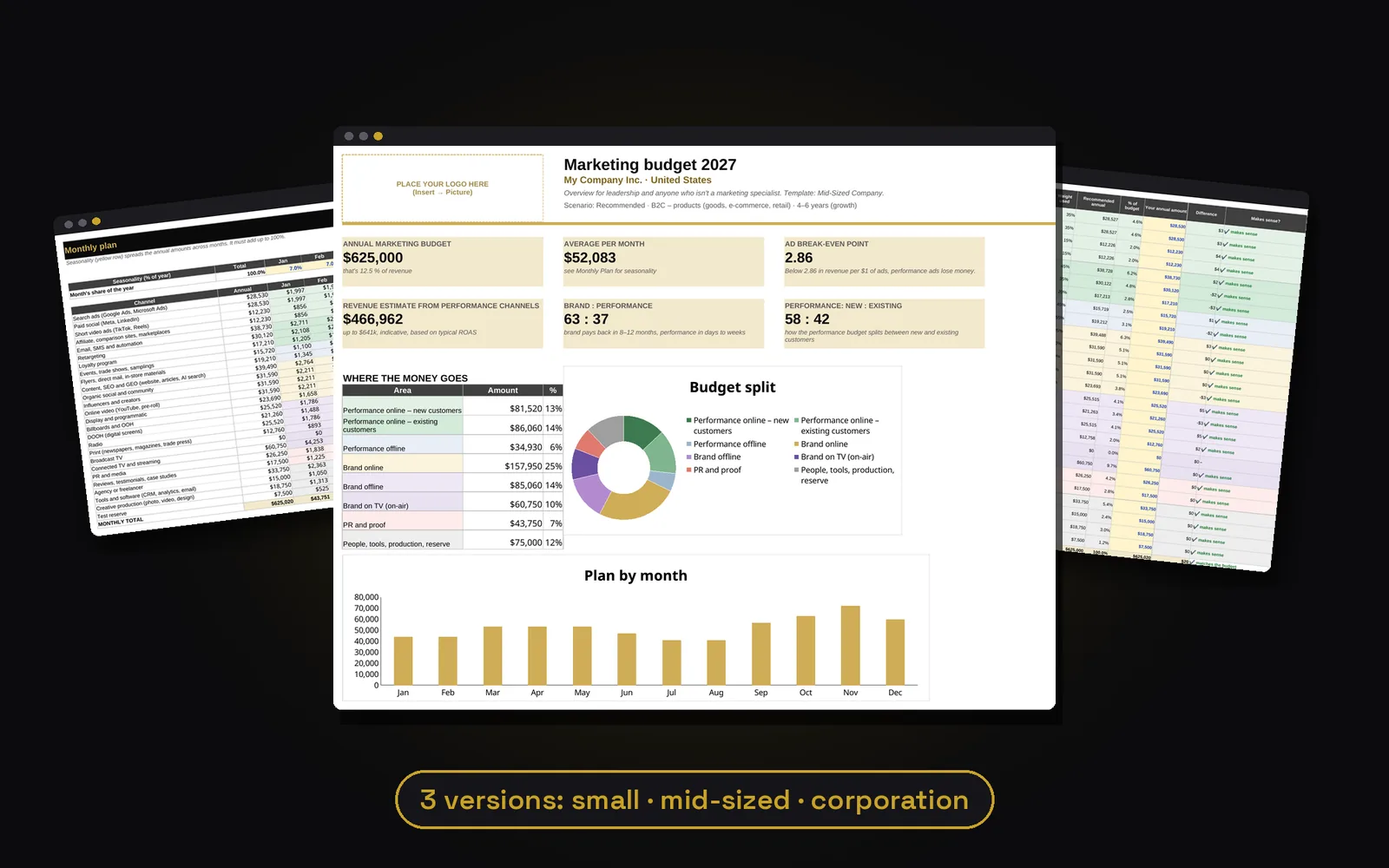
📊 Building your 2027 marketing budget? The Pro Excel template gets it done in an afternoon: three versions by company size, a leadership overview, 26 channels and a monthly plan. For a small business, the free template is enough.
Source: Michal Krčmář, 20 years of marketing experience (Nintendo CEE, JIP východočeská, iGaming, startups) - real-world practice, not theory.
Exclusive
The rest is for early adopters
Until 20 January 2027 you get free access to every exclusive article in exchange for your contact - as an early adopter you also get 50% off the first year of the subscription once we launch it.
What's the difference between a marketing strategy and a marketing plan?
Strategy decides what's worth doing: who you want to win, what problem of theirs you solve, why they should choose you, where they decide and what you'll stop doing. The plan is the calendar: who does what, and when. A plan without a strategy means a full calendar with no clear reason behind it.
What's the difference between strategy and tactics?
Strategy is the route to your goal. Tactics are the specific moves along that route. "Bet on regulars, not bargain hunters" is a strategy. "Book the next appointment at checkout" is a tactic. A social platform like TikTok is a channel or a tactic, not a strategy.
How many new businesses survive five years?
About half. In the US, 51.4%, and in Florida, 50.1% (BLS data). In the EU, 45% (Eurostat), and in the Czech Republic, about 47% (Czech Statistical Office, 2026). After the first year, 77.9% of new US establishments are still operating, compared with 80.5% in the EU.
Why do startups fail?
According to CB Insights (2026, 431 venture-backed startups that shut down), 70% ran out of money, but that's usually the final cause, not the root. The root is often that the market didn't want the product (43%) or poor timing (29%). Roughly 1% of startups with a first funding round become unicorns.
How do I write a one-page marketing strategy?
Answer five questions: who we want to win, what problem of theirs we solve (in their words), why they should pick us and how we prove it, where they decide (Google, AI, other people) and what we'll stop doing. One owner, reviewed every quarter. Only then build the calendar.