The numbers that explain it
According to Pew Research Center, 32% of U.S. adults use WhatsApp (as of 2025, up from 23% in 2021), with total reach of over 100 million monthly active users in the country. That sounds like a lot - until you put it next to the global number: WhatsApp has more than 3.3 billion monthly active users worldwide. The U.S. is one of the few major markets where WhatsApp is nowhere near the dominant messaging channel.
And that gap isn't evenly distributed - it's heavily concentrated in specific groups, which matters a lot for targeting:
- By ethnicity: Hispanic population 56%, Asian American population 39%, Black population 36%, White population just 22%.
- By income: households earning over $100,000/year 37%, households earning under $30,000/year 26%.
- By location: urban 39%, suburban 31%, rural just 19%.
- By age: the distribution is surprisingly flat - 30% among 18-29 year-olds, 40% among 30-49 year-olds (the highest group), 28% among 50-64 year-olds.
In other words, WhatsApp in the U.S. isn't "an app for young people" or "an app for everyone" - it's a channel strongly skewed toward Hispanic and Asian American populations, urban areas, and higher-income households. A campaign that targets WhatsApp without accounting for this distribution can end up missing most of its intended audience in practice.
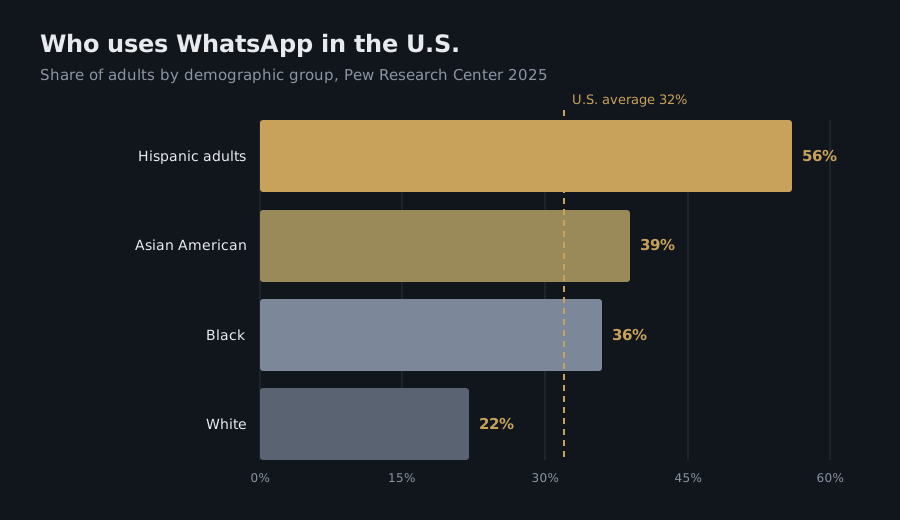
Source: Pew Research Center, 2025 (via Sinch).
What it looks like in practice when a company gets WhatsApp right
That WhatsApp can significantly outperform blanket communication within a targeted segment is shown by specific brands outside the U.S., in markets where penetration is high. The Financial Times found that readers who clicked through to their content via WhatsApp returned to the site within three days 40% more often than readers from other channels - a clear sign that WhatsApp as a channel produces higher-quality, more engaged audiences, not just more clicks. Hellmann's, meanwhile, ran a "WhatsCook" campaign across Latin America (Brazil, Argentina, Chile, Uruguay, Paraguay) where 13,000 people signed up for a one-on-one cooking consultation over WhatsApp - with an average interaction time of 65 minutes per participant, a level of engagement no blanket email or SMS campaign comes close to.
In fairness, neither of these examples specifically targets the U.S. Hispanic community - both are campaigns from markets where WhatsApp is dominant across the entire population. A well-documented, publicly available case study specifically targeting the U.S. Hispanic audience via WhatsApp wasn't something I could find - which itself says something about how new this opportunity still is for companies operating in the U.S.
Expert perspective: "Segmenting by channel, not just by age or interests, is exactly what companies expanding into the U.S. most often underestimate. It's not about writing off WhatsApp - it's about deploying it where it actually fits, and relying on SMS everywhere else," says **Michal Krčmář, founder of Don Marketer and a CMO with nearly two decades of experience in global marketing.
Why that's the case - and why it's not "American backwardness"
It's tempting to assume Americans are simply behind on communication technology. The reality is different, and it makes sense once you look at how the U.S. mobile market functioned back when WhatsApp was taking off elsewhere in the world.
Most U.S. mobile plans have long included unlimited SMS and MMS as a standard part of the package, and the iPhone (with its high U.S. market share) comes with iMessage built in, which works seamlessly and for free between Apple users - including group chats, read receipts, and media sharing, exactly the features that drove people elsewhere in the world to switch to WhatsApp. European and Latin American users had a strong reason to look for an alternative to expensive or limited SMS. American users never had that reason - their "default" solution was free from the start and worked well.
That means SMS and iMessage in the U.S. aren't "a legacy channel that WhatsApp will replace" - they're functionally strong, deeply entrenched channels with reach that WhatsApp isn't going to catch up to anytime soon.
What this means for your campaign
If you're planning to communicate with customers in the U.S. (or specifically in Miami, where you're headed), the simplified "what works at home will work there too" doesn't apply. The practical takeaway:
- Use SMS/iMessage as your primary direct channel for a general U.S. audience, not WhatsApp - you'll reach a much broader base that way.
- WhatsApp makes sense as a supplementary, targeted channel - specifically if your audience includes the Hispanic or Asian American community, or younger and middle-aged adults in higher-income urban areas, where WhatsApp's reach genuinely competes with SMS.
- Never assume consent for one channel implies consent for another. This matters legally too - in the EU/Czech Republic (the ePrivacy Directive) and in the U.S. (TCPA for SMS), separate, explicit consent is required for each direct communication channel - it can't be inferred just because someone left a phone number "just in case."
This kind of difference between markets - something that looks like a universal truth at home but doesn't hold up elsewhere - is exactly what you need to think about in any international expansion, not just messaging. Currency, campaign language, and even what counts as a "normal" price vary between markets in similarly systematic ways.
Planning to reach customers in multiple countries and want to know how much budget should go where? The calculator breaks it down for you by industry and company stage.
Sources: Pew Research Center - WhatsApp usage in the U.S. (via Sinch, 2025); WhatsApp Statistics 2026 - Backlinko; WhatsApp Statistics 2026 - Demandsage; 5 Brands Using WhatsApp for Marketing - HubSpot.