Is Your 2027 Marketing Budget Due Friday? This Excel Gets It Done in an Afternoon
Michal Krčmář · founder Don Marketer
Is Your 2027 Marketing Budget Due Friday? This Excel Gets It Done in an Afternoon
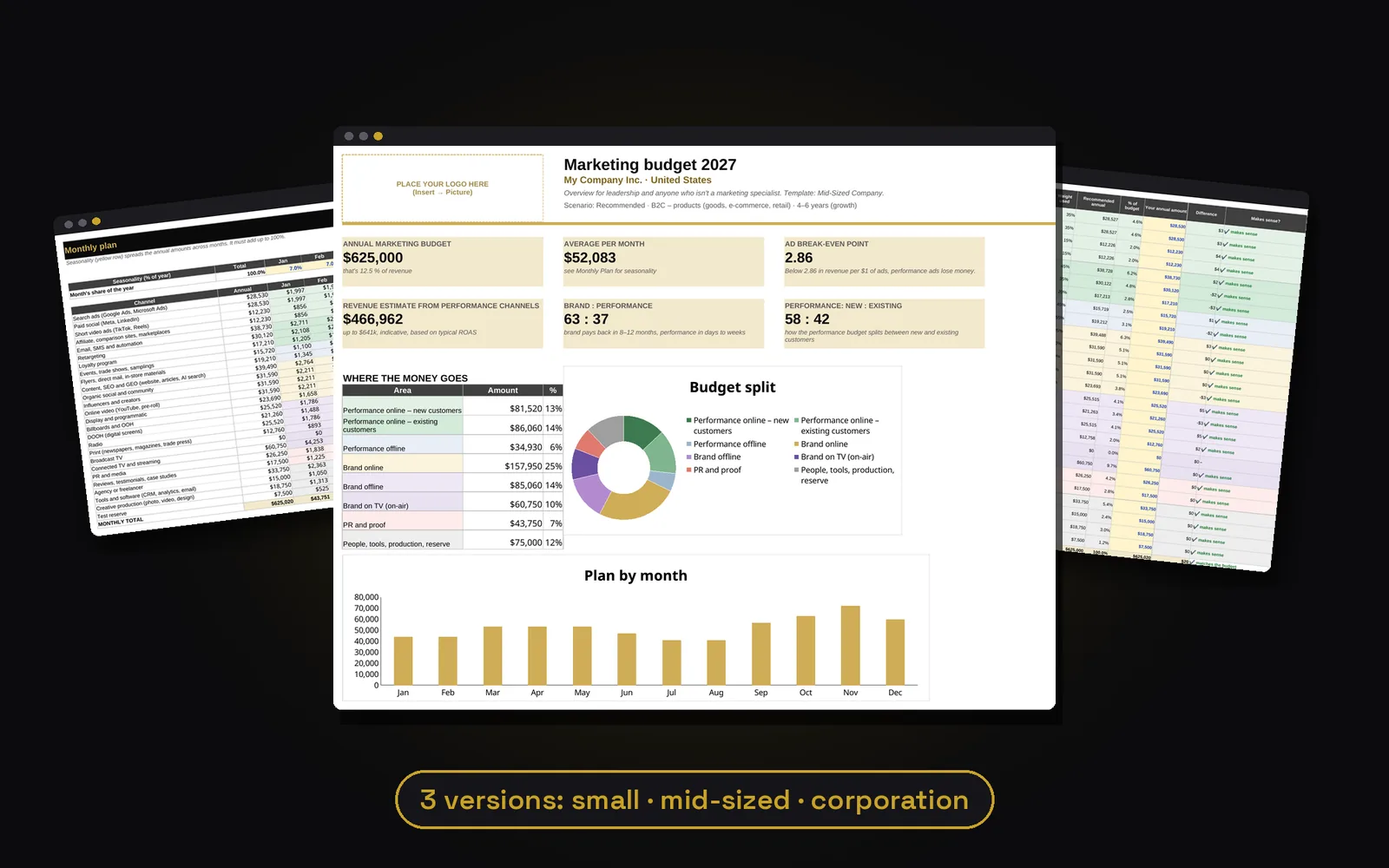
How do you build a 2027 marketing budget fast? In five steps: set a percentage of revenue based on your industry and company stage (Gartner puts the average around 7.7% of revenue), work out the point below which ads lose money (1 ÷ margin), split the money between brand and performance and between new and existing customers, pick the channels your budget can actually support, and break it down by month. That's exactly what the [Don Marketer Pro Excel template](/en/guides#budget-2027) does for you, in three versions: small business, mid-sized company and corporation.
December. Your CFO wants next year's marketing budget by Friday. You have last year's spreadsheet, three agency proposals, a wish list from sales, and a calendar full of holiday parties, two kickoffs and year-end close. And then comes the question I've heard at every company I've ever worked for: "Why that number?"
In nearly twenty years, I've built budgets in corporations, in iGaming and in startups. And it almost always went the same way: last year's number plus five percent, a few extra channels because the boss wants them, and a quiet prayer that nobody asks about return.
So I took what I've been doing by hand for twenty years and put it into one Excel file. At the end of this article, I'll show you how to use it to build a budget your CFO will sign off on, in one afternoon instead of three weeks.
Unlock the article to get:
the three mistakes that get a budget sent back by the CFO,
five things a budget must include for leadership to approve it,
when TV, billboards, DOOH, influencers or print start to pay (and when they don't at all),
everything inside the Pro Excel template and how to build your 2027 budget with it in an afternoon,
when the free template is enough and when you need the version for mid-sized and large companies,
what it all means for a hair salon and for a corporation in Miami.
The article continues below - unlock it free as an early adopter.
Three mistakes that get a budget sent back
1. Last year plus five percent. The most common method in the world. And the hardest to defend. Your CFO asks "why five and not zero?" and you have no answer. A budget is set from revenue and from the company's stage, not from what was spent last year. (Why revenue and not profit is in a separate article.)
2. A list of channels instead of a strategy. A billboard because the competitor has one. TikTok because the boss wants it. A trade show because "we go every year." Full calendar, flat revenue. (More in You Have a Plan, Not a Strategy.)
3. No break-even point. To a CFO, a budget without the number below which ads lose money is just a list of costs. With that number, it's an investment they can check.
Five things a budget must include for leadership to approve it
What percentage of revenue, and why. A number compared with the benchmark for your type of business and stage. Gartner puts the average around 7.7% of revenue. A new business needs more, an established one can spend less.
The ad break-even point. 1 ÷ margin. With a 35% margin, every $1 in ads must bring back at least $2.86 in revenue.
Brand vs. performance. Performance pays back in days to weeks, brand in 8–12 months. Put everything into performance, and in two years you pay twice as much per customer.
New vs. existing customers. A young company mainly needs to win customers, an established one mainly to keep them. (Why there's no retention without acquisition is here.)
A monthly plan and an "actual" column. So you can tell in March whether it's working, not in December.
When do TV, billboards, DOOH or influencers pay off?
This is the question I get most. The answer: only once there's at least the minimum amount for that channel to have any effect. A few indicative US numbers:
Channel
Indicative price
Practical minimum to have an effect
Broadcast TV
local $500–$10,000 a month, regional cable $1,000–$20,000; professional spot production $10,000–$50,000 (Adwave, 2026)
about $100,000 a year on TV
Connected TV and streaming
CPM $15–$40+, campaigns from about $500–$1,000 a month (Adwave, 2026)
about $10,000 a year
Billboards and OOH
programmatic billboard CPM $6–$10, premium sites $15–$25 (Vistar Media, 2025)
about $3,000 a year
DOOH (digital screens)
programmatic typically $6–$10 CPM (Vistar Media, 2025)
about $5,000 a year
Influencers
micro-influencers $500–$3,000 per post (Later, 2026)
about $1,500 a year
The minimums are my rules of thumb from practice, not hard data. Below them, money tends to dissolve rather than do anything. If your budget leaves only $20,000 for broadcast TV, put it into connected TV instead, where the same money reaches a specific region or audience.
What's inside the Pro Excel template
You fill in five yellow cells: revenue, margin, business type, stage and whether you measure success online or offline. Everything else calculates itself.
A CEO overview on page one. Space for your company logo, annual and monthly budget, break-even point, a revenue estimate from performance channels, charts and "5 things leadership should know" in plain English. Print it or save it as PDF and send it to leadership.
26 channels in eight groups, from search and email to influencers, billboards, DOOH, radio, print and TV. Each with an expert note.
Minimum checks. A channel that would get less than it needs gets zero, and the money moves where it can do something. If you overwrite an amount below the minimum, the template warns you.
A monthly plan with seasonality and a plan vs. actual tab that shows whether your ads are profitable.
A "When a channel pays" guide with prices and when to say yes or no.
A multi-market tab. One file per country and a group summary in one currency, for companies operating in several countries.
Three versions: small business and solo founder, mid-sized company, large company and corporation. They differ in defaults, such as how much it makes sense to put into TV or support.
The math uses the same methodology as the Don Marketer calculator: Gartner and The CMO Survey benchmarks, the Binet & Field rule for brand vs. performance, and my own experience.
Is the free template enough, or do I need the Pro version?
If you run a small business and just want to know quickly how much to spend on marketing and roughly how to split it, the free marketing budget template is enough. One table, four parts of the budget, done.
The Pro Excel template is for when you have to defend the budget to leadership or a CFO: specific channels, minimums, seasonality, plan vs. actual and an overview anyone outside marketing understands. Typically mid-sized and large companies, marketing managers and agencies preparing a budget for a client.
Expert perspective:"A budget put together over two evenings in December decides the whole next year. CFOs don't reject marketing. They reject numbers nobody explained. Give them the percentage of revenue, the break-even point and a monthly plan, and the fight turns into a conversation," says Michal Krčmář, founder of Don Marketer and a CMO with nearly two decades in global marketing.
For a hair salon: next year's budget doesn't have to be complicated. Download the free template, enter revenue and margin, and you'll see how much you can put into ads and still get it back. There probably won't be enough for billboards or radio yet. There will be for Google, Instagram and text messages to your regulars.
For a corporation in Miami: give the marketing team one copy of the Pro template per market, with the same methodology. On the multi-market tab, leadership sees the group budget in one currency and, more importantly, numbers that can be compared across countries.
The takeaway
You can build your 2027 budget in an afternoon. Just not from last year's spreadsheet plus five percent. You need a percentage of revenue with a benchmark, a break-even point, a brand vs. performance split, channels your money can actually support and a monthly plan.
A test for tonight: open last year's budget and try to answer your CFO's three questions. Why that number? Below what number do ads lose money? And how will we know in March that it's working? If you can't answer any of them, you know where to start.
The Pro Excel marketing budget template for 2027, $25: three versions by company size, a leadership overview on page one, 26 channels with minimum checks and plan vs. actual. Download it right after payment.
Source: Michal Krčmář, 20 years of marketing experience (Nintendo CEE, JIP východočeská, iGaming, startups) - real-world practice, not theory.
Exclusive
The rest is for early adopters
Until 20 January 2027 you get free access to every exclusive article in exchange for your contact - as an early adopter you also get 50% off the first year of the subscription once we launch it.
Set a percentage of revenue based on your industry and stage, work out the ad break-even point (1 ÷ margin), split the money between brand and performance and between new and existing customers, choose the channels your budget can support and break everything down by month. The Don Marketer Pro Excel template calculates this from five inputs.
What percentage of revenue should go to marketing in 2027?
According to Gartner, the average sits around 7.7% of revenue. A new business needs more (often 12–20%), an established one can spend less. It depends on industry, margin and whether you sell to businesses or consumers.
What should a marketing budget for leadership include?
The percentage of revenue compared with a benchmark, the ad break-even point, the brand vs. performance split, the new vs. existing customer split, specific channels, a monthly plan and a column for actual results.
When does TV advertising pay off for a business?
Only once there's enough for the campaign to have real weight, plus spot production. Local broadcast TV runs about $500–$10,000 a month (Adwave, 2026). With a smaller budget, connected TV and streaming usually make more sense, with local targeting.
Is there a free marketing budget template?
A simple template for small businesses is free to download on Don Marketer. The Pro Excel template with three versions by company size, a leadership overview, 26 channels with minimum checks and plan vs. actual costs $25.